Show Your Work! A Summary, with My Highlights
Austin Kleon’s ten ways to share your creativity and get discovered, one by one, with the notes I typed in my Kindle copy.
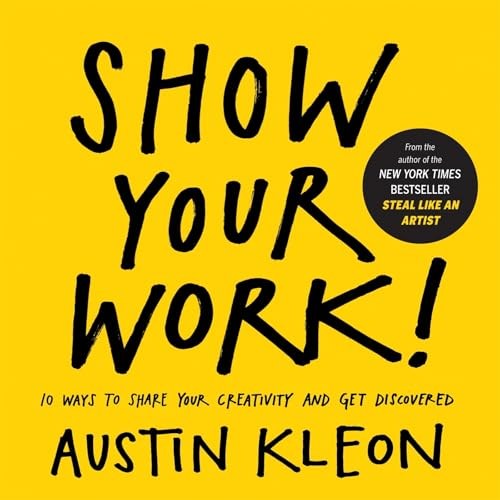
My Kindle copy of Show Your Work! has 61 highlights and 11 notes typed in the margins. Austin Kleon wrote it as the follow-up to Steal Like an Artist. The first book is about making things; this one is about sharing them.
It’s short, hand-drawn in places, and built on one idea: you don’t have to promote yourself if you get in the habit of showing what you’re working on. Be findable, share a little every day, teach what you know, and the people who care about the same things will find you.
- Show Your Work! at a Glance
- The 10 Ways, One by One
- Show Your Work, on This Site
- My Highlights
- The Workbook
- Resources
Show Your Work! at a Glance
- You Don’t Have to Be a Genius. Good work comes out of a scene of people, not a lone genius, so be an amateur and start sharing what you’re learning.
- Think Process, Not Product. People want to see how you work, not only what you finish. Keep a record of it as you go.
- Share Something Small Every Day. Post one small piece of your process each day, ask whether it’s worth sharing, and keep your own home on the web.
- Open Up Your Cabinet of Curiosities. Share what inspires you, not only what you make, and always give credit.
- Tell Good Stories. Work doesn’t speak for itself. Learn the shape of a good story and how to say plainly what you do.
- Teach What You Know. Share your trade secrets. Teaching doesn’t cost you anything, and it makes people care about your work.
- Don’t Turn into Human Spam. Sharing is a two-way street. Listen, be interesting by being interested, and meet your people in person.
- Learn to Take a Punch. Sharing invites criticism. Get used to it, learn from what’s useful, and ignore the trolls.
- Sell Out. It’s fine to make money from your work. Ask for it, keep a mailing list, and pay it forward.
- Stick Around. Keep going. Careers have ups and downs, so don’t quit, start the next thing, and take breaks when you need them.
The 10 Ways, One by One
1. You Don’t Have to Be a Genius
- Find a scenius. Brian Eno’s word for it: great ideas usually come from a whole scene of people, artists, curators, fans and friends, feeding each other. You don’t have to be a genius to belong to one. Ask what you can give to yours.
- Be an amateur. Amateurs do things for love and aren’t afraid to look foolish. Commit to learning something in front of others, and share what you pick up as you go.
- You can’t find your voice if you don’t use it. Talk about what you love. If your work isn’t online, most people will never know it exists.
- Read obituaries. Remembering that you’ll die is a good way to stop wasting time and start doing the work.
2. Think Process, Not Product
- Take people behind the scenes. The finished thing is only part of the story. Showing your process lets people feel connected to you and to the work.
- Become a documentarian of what you do. Keep a notebook, take photos at each stage, save the scraps. You’re not making art, just keeping track of what’s happening.
3. Share Something Small Every Day
- The daily dispatch. Overnight success usually takes years. Forget the years and focus on today: once a day, after you’ve done your work, share one small piece of it.
- The “So what?” test. Before you post, ask whether it’s helpful or entertaining, and whether you’d be fine with your boss or your mother seeing it.
- Turn your flow into stock. Daily posts are the flow. Gather the best of them over time into something lasting: a collection, a book, a body of work.
- Build a good (domain) name. Own a website with your own name on it. Social sites come and go, but your site is where your work lives. Think of it as a place to invent yourself, not to promote yourself.
4. Open Up Your Cabinet of Curiosities
- Don’t be a hoarder. Your influences say a lot about who you are. Share the books, people and ideas that shaped you.
- No guilty pleasures. If you love something, love it openly. Being honest about what you like is how people who like the same things find you.
- Credit is always due. When you share someone else’s work, say who made it and link back to them.
5. Tell Good Stories
- Work doesn’t speak for itself. People care about a thing more when they know the story behind it, so tell it.
- Structure is everything. Good stories follow a shape: a character wants something, runs into trouble, and comes out changed. You can tell an unfinished story too, about where you are right now.
- Talk about yourself at parties. When someone asks what you do, answer plainly and humbly, in a way anyone could understand. Not as a pitch, but as a way to connect.
6. Teach What You Know
- Share your trade secrets. Teach what you know: your techniques, your tools, your reading list. Like the chefs in Rework who give away their recipes, you lose nothing, and people want more of your work. Make people better at something they want to be better at.
7. Don’t Turn into Human Spam
- Shut up and listen. Don’t be the person who only wants attention for their own work. If you want fans, be a fan first.
- You want hearts, not eyeballs. A few people who really care beat a crowd of people who don’t.
- Be an open node. Make stuff you love, talk about it, and you’ll attract people who love the same things. Keep away from people who drain you.
- Meet up in meatspace. When you find your people online, meet them face to face. Nothing replaces it.
8. Learn to Take a Punch
- Let ’em take their best shot. The more you share, the more criticism you’ll get. Relax, breathe, and stay focused on the work. The more you’re hit, the better you get at taking it.
- Don’t feed the trolls. Some criticism is useful and some is just meant to hurt. Learn the difference, and don’t answer the second kind.
9. Sell Out
- Even the Renaissance had to be funded. Artists have always needed patrons. Don’t be ashamed to ask people to pay for your work.
- Keep a mailing list. Email is old and dull and it works. The people who sign up actually want to hear from you.
- Make more work for yourself. When success brings new chances, say yes to the ones that let you do more of the work you love.
- Pay it forward. Use whatever success you have to help the people who helped you, and the ones coming up behind you.
10. Stick Around
- Don’t quit your show. The people who make it are the ones who stick around long enough.
- Chain-smoke. Finish one project and go straight into the next, so you never stall waiting for the last one to land.
- Go away so you can come back. Take a sabbatical when you need one. Step away, refill, and return to the work.
Show Your Work, on This Site
In December 2016 I hand-lettered a card that says Show Your Work, and drew it again in three stages so you can see the process. One of the free classes in my Optimist Program has the same name. And this website is built in public: Evolution shows how it changed, day by day.
My Highlights
My Kindle copy of Show Your Work! has 61 highlights and 11 notes typed in the margins.
Here are the eight places where I stopped to write something. Each passage is retold in plain words, with my note beside it exactly as I typed it, and its Kindle location so you can find Austin’s own words.
- Highlights
- A note I wrote in the margin
Most highlighted: Locations 1–99, 18. Most notes: Locations 400–499, 5.
See the numbers
| Pages | Highlights | Notes |
|---|---|---|
| Locations 1–99 | 18 | 2 |
| Locations 100–199 | 10 | 1 |
| Locations 200–299 | 7 | 1 |
| Locations 300–399 | 2 | 1 |
| Locations 400–499 | 10 | 5 |
| Locations 500–599 | 13 | 1 |
| Locations 600–699 | 0 | 0 |
| Locations 700–799 | 1 | 0 |
This Kindle edition records locations, not print pages, so the chart counts in stretches of 100 locations, from the start of the book to the end.
Then do what the book says and share. You get three flags. Stick them on the three ideas you would keep.
Give what you have
“Give what you have. To some one, it may be better than you dare to think.” Henry Wadsworth Longfellow
Kindle location 43
love!
Learn it out loud
The easiest way to start sharing is to pick something you want to learn and promise to learn it where other people can watch. You don’t have to be an expert. Being a beginner out loud is the point.
Kindle location 95
wow
Your voice comes from using it
Austin used to think he had to find his voice before he could share anything. He learned it works the other way around: you find a voice by using it. Talk about what you love, and the voice follows.
Kindle location 103
great
Build a good name
A piece of advice Austin passes along: keep your name clean, and care more about doing good work than about money or success. Over time, a good name becomes worth something on its own.
Kindle location 301
love
You’re already telling a story
Every email, post, photo and conversation is a piece of a story about your work, whether you mean it or not. So learn what makes a good story, and how to tell one.
Kindle location 408
wow
The story spine
A fill-in-the-blanks shape for a story that Pixar’s storytellers made famous: who and where, what happened every day, the day something changed, what followed from that, and how it finally ended. Almost any story fits it.
Kindle location 422
wow pixar
What’s your cookbook?
Jason Fried and David Heinemeier Hansson, who wrote Rework, tell businesses to act like famous chefs and give away their recipes. Ask what you could teach the world about how you work.
Kindle location 498
wow
Meet face to face
The internet is a great way to find your people, but the comedian Rob Delaney’s point stands: nothing replaces meeting in person. When you find people you like online, go and meet them.
Kindle location 594
nice
Two more notes became the workbook below. One more, a “yes!” at location 203, sits on a highlight my Kindle no longer shows, so I can’t tell you what I was agreeing with.
Your three flags
I send one short essay every Saturday morning, on optimism, purpose and enough.
The Workbook
Two of my margin notes sit next to the book’s advice on explaining and teaching your work. Here they are as questions you can answer, with my note beside each.
What you write is saved in this browser and nowhere else.
What do you do, plainly?
Austin says your work should make sense to a five-year-old and a grandparent alike. In one plain sentence, what do you do?
Your cooking show
If your work had its own cooking show, what would you show people? Which of your techniques, tools or know-how could you teach to the people you want to reach?
Resources
- Show Your Work! on Amazon
- austinkleon.com, Austin Kleon’s blog and newsletter
- Steal Like an Artist, my summary of the first book
- Rework, where the “cookbook” idea comes from
- More of my book summaries and reviews on Books I Love