Rework: A Summary, with My Highlights
Jason Fried and David Heinemeier Hansson’s short, blunt book on building a business small on purpose, section by section, with the notes I typed in my Kindle copy.
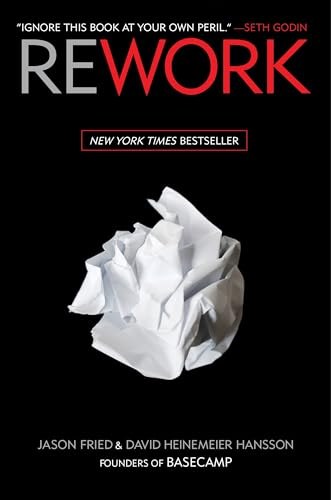
Rework is on my list of books I love, and my Kindle copy is one of my most marked-up: 231 highlights and 30 notes typed in the margins. Only Essentialism has more notes.
Jason Fried and David Heinemeier Hansson built 37signals (now Basecamp) small on purpose, and Rework is what they learned doing it: dozens of short, blunt essays, most just a page or two, grouped into a dozen sections. The big idea runs through all of them: you need less than you think. Less money, less planning, fewer meetings, fewer people and fewer features, and more focus on the work itself.
Rework at a Glance
- First. The new reality: the tools are cheap, you can start on the side, and anyone can build a business now.
- Takedowns. The business advice they think you can ignore, from “the real world” to long plans and growth for its own sake.
- Go. Starting: make something you need yourself, stand for something, and spend less than you think you need.
- Progress. Making it: use your limits, build half a product instead of a half-baked one, cut, decide and ship.
- Productivity. Getting it done: protect long stretches of alone time, avoid meetings, and break big work into small pieces.
- Competitors. Don’t copy. Put yourself into what you make, pick a fight, and do less than the competition.
- Evolution. Growing the product: say no by default, let customers outgrow you, and listen for the requests that keep coming back.
- Promotion. Getting noticed: build an audience, out-teach the competition, and show people behind the scenes.
- Hiring. Hiring: do the job yourself first, hire only when it hurts, and look for managers of one and great writers.
- Damage Control. When things go wrong: tell the bad news yourself, answer fast, apologize like a person and keep everyone close to customers.
- Culture. How it feels to work there: trust people, send them home on time, skip the policies and talk like a human.
- Conclusion. Inspiration is perishable: when it shows up, use it now.
Rework, Section by Section
First
- The new reality. What once took money, an office and a staff now takes a laptop and a few cheap tools. You can start a business on the side while keeping your job, and you don’t need anyone’s permission.
Takedowns
- Ignore the real world. “That would never work in the real world” is usually an excuse from people who have stopped trying something new.
- Learning from mistakes is overrated. A failure mostly teaches you what not to do next time. Study what worked, and do more of it.
- Planning is guessing. Long-range plans pretend to know a future nobody can see. Decide what you’ll do this week, not this year.
- Why grow? Small isn’t a stepping stone. Find the right size for your company and be happy to stay there.
- Workaholism. Working late isn’t heroic. Tired people make worse decisions and make everyone else look lazy for going home.
- Enough with “entrepreneurs.” You don’t need the title. Anyone who starts something is a starter.
Go
- Scratch your own itch. The simplest way to make something great is to make what you want to use yourself.
- Start making something. Ideas are cheap. What you do matters, not what you plan or say.
- No time is no excuse. When you want something enough, you find the time, an hour a night instead of TV.
- Draw a line in the sand. Stand for something. Some people will dislike it, and that’s how you know it means something.
- Outside money is plan Z. Investors bring bosses, and you end up building what they want instead of what customers want.
- You need less than you think. Skip the office, the ads and the PR firm until you’ve tried the cheaper ways.
- Less mass. The fewer commitments, contracts and layers you carry, the faster you can change direction.
Progress
- Embrace constraints. Not enough time, money or people? Limits force simpler, more creative work.
- Build half a product, not a half-baked one. Cut good features so the few that are left can be great.
- Start at the epicenter. Ask what the one part is that the whole thing can’t live without, and build that first.
- Making the call is making progress. Decide now instead of “let’s think about it.” Most choices can be changed later.
- Focus on what won’t change. Build on what people will want just as much in ten years: for 37signals, speed, simplicity and reliability.
- Tone is in your fingers. Fancy tools won’t make you good. Use what you have and get to work.
- Sell your by-products. Everything you make leaves something behind: what you learn, how you work. 37signals turned theirs into blog posts, workshops and books.
- Launch now. Stop guessing what will work. Ship it and find out.
Productivity
- Interruption is the enemy of productivity. Real work happens in long, quiet stretches. Guard an “alone zone” every day.
- Meetings are toxic. They’re mostly talk about abstractions, slow and easy to drift. If you must meet, set a timer, invite few people, start with a specific problem and end with a decision and an owner.
- Good enough is fine. Look for the simple, “judo” solution that gets most of the result for little effort.
- Quick wins. Momentum comes from finishing things. Ask what you can do in two weeks, then do it.
- Go to sleep. Skipping sleep costs you creativity, morale and patience.
- Your estimates suck. Nobody is good at guessing big projects. Break the big thing into small pieces you can estimate.
- Long lists don’t get done. Keep to-do lists short, and make tiny decisions you can act on.
Competitors
- Don’t copy. Copying skips the understanding. Make your product so personal that nobody else could make it.
- Pick a fight, and underdo. Know what you’re against, and beat the competition by doing less, but better.
- Who cares what they’re doing? Pay attention to your own work and your customers, not to the other company.
Evolution
- Say no by default. Every yes adds weight. Keep the product right for you, even if some customers outgrow it.
- Be at-home good. Make something that keeps getting better once people use it, not something that only shines in the store.
- Don’t write it down. You don’t need a list of feature requests. The ones that matter, you’ll hear again and again.
Promotion
- Build an audience. All companies have customers; the lucky ones have an audience. Share what you know by writing, speaking and making videos, and the right people will already be listening when you need them.
- Out-teach your competition. Big companies can outspend you, but they won’t teach. Teaching earns loyalty that advertising can’t.
- Emulate chefs. Famous chefs give away their recipes in cookbooks and on TV, and it only makes people want their food more.
- Go behind the scenes. Show people how your business really works, as if someone were filming a reality show about it.
- Marketing is not a department. Every email, every word on your site and every phone call is marketing. It’s the sum of everything you do.
- The myth of the overnight sensation. Overnight successes usually took years. Start building your audience now and keep going.
Hiring
- Do it yourself first. Don’t hire for a job you’ve never done. You’ll know what good looks like and manage it better.
- Hire when it hurts. Hire only when there’s more work than you can handle, not before. (In my copy of Essentialism, I wrote “rework agrees” next to its advice on hiring slowly.)
- Resumés are ridiculous. Read the cover letter. You want someone who wants this job, not any job.
- Hire managers of one. Look for people who set their own goals and see things through without supervision.
- Hire great writers. Clear writing is a sign of clear thinking, whatever the job.
- The best are everywhere. Hire talent wherever it lives, and get the whole team together a few times a year.
- Test-drive employees. Pay someone for a small real project before you hire them. Real work shows what interviews can’t.
Damage Control
- Own your bad news. Tell people what went wrong before someone else does.
- Speed changes everything. Answer customers quickly and personally. “Let me look into it” beats a canned reply.
- How to say you’re sorry. Take responsibility with no “if,” explain what happened and what you’ll do to keep it from happening again, and make it right.
- Put everyone on the front lines. Everyone in the company should hear from customers now and then.
- Take a deep breath. When people complain about a change, wait. Most first reactions settle down.
Culture
- You don’t create a culture. It grows from what you do every day. Culture is action, not ping-pong tables or slogans.
- Skip the rock stars. Build a place where people do their best work: trust, room and the right tools.
- They’re not thirteen. Treat people like adults. Monitoring and rule books cost more than trust.
- Send people home at five. You don’t need more hours; you need better ones. Busy people with lives outside work get things done.
- Don’t scar on the first cut. Don’t write a policy because one person made one mistake.
- Sound like you. Write the way you talk, to one person, without buzzwords.
- Four-letter words, and ASAP is poison. Words like need, must, easy and fast shut down conversations, and once everything is ASAP, nothing is.
Conclusion
- Inspiration is perishable. Ideas last; inspiration doesn’t. When it grabs you, put it to work right away.
My Highlights
My Kindle copy of Rework has 231 highlights and 30 notes typed in the margins. Only Essentialism has more notes, of the 191 books on my Kindle.
Here are the 22 places where I stopped to write something. Each passage is retold in plain words, with my note beside it exactly as I typed it, and its Kindle location so you can find the authors’ own words.
- Highlights
- A note I wrote in the margin
Most highlighted: Progress, 39. Most notes: Culture, 6.
See the numbers
| Chapter | Highlights | Notes |
|---|---|---|
| First | 6 | 0 |
| Takedowns | 5 | 0 |
| Go | 25 | 1 |
| Progress | 39 | 3 |
| Productivity | 28 | 3 |
| Competitors | 10 | 0 |
| Evolution | 7 | 0 |
| Promotion | 32 | 5 |
| Hiring | 28 | 5 |
| Damage Control | 14 | 3 |
| Culture | 31 | 6 |
| Conclusion | 6 | 4 |
This Kindle edition records locations, not print pages, so each highlight is counted in the section it sits in. The few in the thank-yous at the back are counted with the conclusion.
Then do what the book would: keep less. You get three flags. Stick them on the three ideas you would keep.
You need less than you think
Before you pay for advertising or a PR firm, ask whether there’s a cheaper, more personal way to get noticed. Most new businesses can skip both.
Go, Kindle location 386
stickers, tshirts
Sell your by-products
37signals turned what it learned building software into blog posts, then workshops, then a PDF, then a paperback. That by-product earned them more than a million dollars, and the book you’re reading is one too.
Progress, Kindle location 593
This is HUGE!!!!
Meetings are toxic
The worst interruption of all is the meeting. Meetings trade in words and ideas instead of real things, pass along very little per minute, drift off topic, and need preparation nobody has time for.
Productivity, Kindle location 704
genius
If you have to meet
Set a timer and stop when it rings. Invite as few people as you can. Have a clear agenda that starts with one specific problem, meet where the problem is, point at real things, and finish with a solution and someone responsible for it.
Productivity, Kindle location 720
genius
Break it into smaller things
Nobody estimates big projects well. Split the big thing into small pieces: they’re easier to estimate, and when a small piece runs twice as long, you’re weeks late instead of months.
Productivity, Kindle location 797
12 week year
Customers, fans, audiences
Every company has customers, and the lucky ones have fans. The luckiest have an audience, and an audience can be a secret weapon.
Promotion, Kindle location 1024
boom
So build one
Speak, write, blog, post, make videos: share what’s useful and a loyal audience grows slowly. Then when you have something to announce, the right people are already listening.
Promotion, Kindle location 1036
exactly
Give a backstage pass
Show people how your business actually works. Picture a reality show about your company: what would it show? Stop waiting for someone to film it and share it yourself.
Promotion, Kindle location 1066
huge
Marketing is everything you do
Every email, every word on your website, every error message and every checkout counter is marketing. Those small things matter more than which giveaway goes in a goodie bag.
Promotion, Kindle location 1139
this is why i should love helping with case studies and blog podcast and more at webuid
The overnight success
Start building your audience today and keep at it. In a few years you’ll get to laugh when people call you an overnight success.
Promotion, Kindle location 1154
yes
Hire the better writer
When you’re choosing between candidates, pick the better writer, whatever the job. Clear writing shows clear thinking: good writers make things easy to understand, imagine the reader, and know what to leave out.
Hiring, Kindle location 1264
yes yes yes
See each other in person
A team spread across places should still meet every few months: to look at progress, talk about what’s working, plan, and get to know each other again.
Hiring, Kindle location 1278
playbook
Test-drive new people
Hire someone for a small, real project before you hire them for good. A portfolio, a resumé or an interview tells you something; working together tells you the truth.
Hiring, Kindle location 1291
playbook
Answer like a person
Customers expect canned replies, so a thoughtful, personal answer stands out. Even without the perfect answer, say something: “let me look into it and get back to you” goes a long way.
Damage Control, Kindle location 1329
playbook
A real apology
A good apology takes responsibility with no “if.” It explains what happened, what you’re doing so it won’t happen again, and how you’ll make it right.
Damage Control, Kindle location 1338
playbook
Everyone on the front lines
Everyone on the team should hear from customers, if not every day then a few times a year. The people who build the product feel the problems most when they hear them firsthand.
Damage Control, Kindle location 1368
playbook everyoe is in cusomer service, everyone is in marketing
Culture is action
Culture isn’t a foosball table, a policy, a holiday party or a slogan. Those are things and events. Culture is what you actually do.
Culture, Kindle location 1403
playbook
Trust costs less
Count what distrust costs: monitoring software, people paid to watch other people, rule books nobody reads. Not trusting your team turns out to be very expensive.
Culture, Kindle location 1440
playbook we dont clock you or require crazy things. we trust you.
Write to one person
When you write, don’t picture everyone who might read it. Picture one person and write to them. Writing for a crowd makes you vague; writing to someone makes you clear.
Culture, Kindle location 1478
playbook
The word “easy”
People call other people’s work easy and rarely their own. Theirs is “let me look into it”; yours is “just get it done.”
Culture, Kindle location 1492
so true
ASAP is poison
Stop adding ASAP. Once everything is urgent, any request without it looks unimportant, and the whole office runs on false alarms.
Culture, Kindle location 1505
yes so true. playbook
Inspiration is perishable
On a wave of inspiration you can do two weeks of work in a day. But it won’t wait for you. When it grabs you, grab it back and put it to work now.
Conclusion, Kindle location 1517
true
Nine of my notes say “playbook”: ideas I marked for the company playbook I made with WeBuild. Four more were questions, and they became the workbook below. The other four are notes to myself about my own work, so they stay in my Kindle.
Your three flags
I send one short essay every Saturday morning, on optimism, purpose and enough.
The Workbook
Four of my margin notes were questions, two of them marked “worksheet.” Here they are as questions you can answer, with my note beside each.
What you write is saved in this browser and nowhere else.
What won’t change
The core of a business should rest on what people will want today and ten years from now. In your work, what won’t change? What will people still want from you a decade from now?
Get back to the work
Meetings and handoffs pull people away from real work. What are you doing now that could be avoided, and how could you say no to it and get back to making things?
A manager of one
The best people set their own direction, build things from scratch and see them through without being told. Where could you be your own manager this month?
Room to do great work
Great work grows from trust, freedom and responsibility: privacy, room and the right tools. What would make the place you work a place where people do their best?
Resources
- Rework on Amazon
- 37signals, the company behind the book
- Essentialism and Anything You Want, two more books I’ve summarized about doing less, better
- More of my book summaries and reviews on Books I Love