Essentialism: A Summary of the Disciplined Pursuit of Less
One of my favorite books — Greg McKeown’s case for doing less but better: the mindset, then the three steps, explore, eliminate, execute.
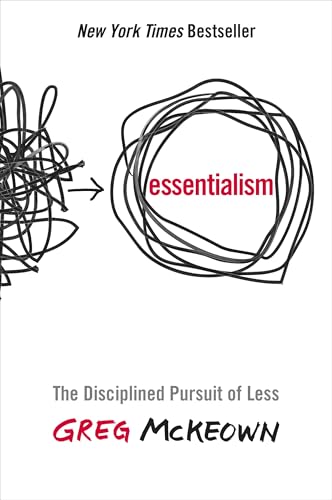
Essentialism
Greg McKeown · The Disciplined Pursuit of Less · Crown Business, 2014
Get the book on AmazonEssentialism is one of my favorite books. It reminds me of simplicity, one of my core values, and it challenges me to focus and put my energy behind the things that are core to me. This website is one of them.
Greg McKeown’s argument is that the way to make your highest contribution isn’t to do more; it’s to do less, but better. The Essentialist isn’t someone who gets more things done. It’s someone who gets the right things done, on purpose, instead of letting everyone else’s priorities fill the calendar.
It sits very close to the idea at the heart of my own book, Enough: that less, chosen well, is where a good life lives. McKeown’s key line is a simple swap in language: stop saying “I have to” and start saying “I choose to.”
The Quick Summary
The Essence: the Essentialist mindset
Explore: discern the trivial many from the vital few
Eliminate: cut out the trivial many
Execute: make it effortless
Essentialism, Explained
The Essence: the Essentialist mindset
- Choose. Your ability to choose can’t be taken away, only forgotten. If you don’t prioritize your life, someone else will.
- Discern. Almost everything is noise, and a very few things are exceptionally valuable. The Essentialist assumes most opportunities are trivial and looks hard for the vital few.
- Trade off. You can’t have it all or do it all. Instead of asking “How can I do both?”, ask “Which problem do I want?” and make the trade-off on purpose.
Explore: discern the trivial many from the vital few
- Escape. Create space to think. Block time on the calendar just to reflect, read and see the bigger picture — focus doesn’t just happen, you have to make room for it.
- Look. Be a journalist of your own life: look past the noise for what really matters. Keep a journal, notice what’s changing, and ask what the lead story is.
- Play. Play isn’t trivial; it fuels creativity, broadens what we see as possible and lowers stress. Make room for it.
- Sleep. Protect the asset. Your best contribution depends on you being rested; one more hour of work often costs more than it earns.
- Select. Use extreme criteria. McKeown’s 90 percent rule: rate an option from 0 to 100, and if it isn’t a 90 or above, treat it as a zero. If it isn’t a clear yes, it’s a clear no.
Eliminate: cut out the trivial many
- Clarify. Set an essential intent: one concrete, inspiring goal that makes a thousand later decisions for you, so you know when you’re done.
- Dare. Learn the graceful “no.” Separate the decision from the relationship; people respect a clear, kind no more than a resentful yes.
- Uncommit. Win big by cutting your losses. Watch out for sunk-cost thinking and ask: if I weren’t already doing this, how much would I work to start?
- Edit. Like a good editor, cut, condense and correct. Subtracting is what makes what’s left clear.
- Limit. Set boundaries ahead of time, so you don’t have to fight the same battle every time someone asks for a piece of your day.
Execute: make it effortless
- Buffer. Plan for the unexpected. Add slack to estimates and prepare for things going wrong, because they will.
- Subtract. Instead of adding more effort, find the one obstacle slowing everything down and remove it.
- Progress. Start small and celebrate small wins. Steady visible progress is the most motivating thing there is.
- Flow. Design routines that make the essential the default, so it happens without having to decide every time.
- Focus. Ask what’s important now. Get present, and do one thing at a time. The final chapter, Be, sums it up: essentialism isn’t something you do once; it becomes who you are.
My Highlights
My Kindle copy of Essentialism has 298 highlights and 40 notes typed in the margins. That is more than any other book on my Kindle, which is a funny thing to do to a book about less.
Here are the 24 places where I stopped to write something. Each passage is retold in plain words, with my note beside it exactly as I typed it. The page numbers match the print edition, so you can find McKeown’s own words in your copy.
- Highlights
- A note I wrote in the margin
Most highlighted: The Essentialist and Dare, 25 each. Most notes: Buffer and Progress, 6 each.
See the numbers
| Chapter | Highlights | Notes |
|---|---|---|
| The Essentialist | 25 | 2 |
| Choose | 12 | 2 |
| Discern | 13 | 1 |
| Trade-off | 13 | 3 |
| Escape | 23 | 0 |
| Look | 13 | 0 |
| Play | 15 | 1 |
| Sleep | 11 | 0 |
| Select | 21 | 2 |
| Clarify | 19 | 4 |
| Dare | 25 | 0 |
| Uncommit | 6 | 2 |
| Edit | 12 | 1 |
| Limit | 15 | 5 |
| Buffer | 14 | 6 |
| Subtract | 15 | 3 |
| Progress | 17 | 6 |
| Flow | 5 | 0 |
| Focus | 13 | 1 |
| Be | 11 | 1 |
The few highlights on each part’s opening pages are counted with that part’s first chapter.
Then try the book’s whole idea in one move. You get three flags. Stick them on the three ideas you would keep.
The Essentialist
Prioritize your life
“If you don’t prioritize your life, someone else will.” Greg McKeown
page 10
i love this quote
Less, but better
The whole discipline in a breath: learn to do less, and do it better, so that every hour you have gives back as much as it can.
page 19
this sums up the book
The Essence
You get to choose
Choice is the center of the whole thing. Becoming an Essentialist starts with noticing, more than you used to, that you are allowed to choose.
Choose, page 38
yes
Believe in free will
“My first act of free will shall be to believe in free will.” William James, quoted in the book
Choose, page 40
nice
Not all effort pays the same
As a boy, McKeown found that washing his neighbors’ cars paid far more than his paper route did. The lesson stuck: some kinds of effort are worth much more than others.
Discern, page 42
paper route to car wash
Decide, or be decided for
Make the hard choices yourself, or your boss, your colleagues and your customers will make them for you.
Trade-off, page 52
yes!
A great company or great ideas
Peter Drucker once gave Jim Collins a choice: grow a great company, or grow great ideas. He couldn’t have the two together. Collins picked ideas. His company stayed at three full-time people, and his writing reached tens of millions of readers.
Trade-off, page 55
wow my life
Explore
What did you play?
Stuart Brown’s way back to play: dig through your childhood. What did you do as a kid that lit you up? How could you do some of it again now?
Play, page 90
i used to climb, lay in the sand. play video games. play cards. play with micro machines. build legos. play football. i miss football a lot. i will ply with any ball. basketball. soccer. frisbee. play board games. sit and talk. play on th computer. sim city. build stuff outside.
Hire slowly
One company in the book starts from a simple rule: better to be short-staffed than to hire the wrong person fast.
Select, page 107
Eliminate
Your main design
“The crime which bankrupts men and states is that of job-work;—declining from your main design to serve a turn here or there.” Ralph Waldo Emerson, quoted in the book
Clarify, page 124
wow
Best Picture needs an editor
When the book came out, no film since 1981 had won Best Picture without at least a nomination for Film Editing. (Birdman broke the streak a year later.)
Edit, page 155
Execute
Sharpen the axe
“Give me six hours to chop down a tree and I will spend the first four sharpening the axe.” Attributed to Abraham Lincoln
Buffer, page 175
Seven fat years
The chapter opens with Joseph reading Pharaoh’s dream: seven years of plenty, then seven of famine. Egypt stores grain while the harvests are good.
Buffer, page 175
great story
Work is a gas
A gas spreads out to fill whatever space it is in. Projects and commitments do the same with whatever time we give them.
Buffer, page 177
that is a fact
Add half again
However long you think something will take, add 50 percent.
Buffer, page 183
so helpful
Subtract for wisdom
The chapter starts with Lao Tzu: you gain knowledge by adding something every day, and wisdom by taking something away.
Subtract, page 185
amazing
Positive Tickets
Ward Clapham, a police leader in Canada, had his officers catch kids doing something right, like wearing a bike helmet or using a trash can, and hand them a ticket good for a movie or a visit to the youth center.
Progress, page 194
send to police dept in woodstock
Tokens for reading
McKeown’s kids each got ten tokens a week. A token bought half an hour of screen time, or 50 cents. Reading for half an hour earned one more. Screen time fell 90 percent overnight.
Progress, page 199
paying kids to read! huge. i love this.
The smallest useful step
Borrow the startup question and aim it at your own work: what is the smallest piece of progress that would still be useful for the thing that matters most?
Progress, page 199
huge
Don’t finish. Release.
John Lasseter said Pixar never really finishes its films. It releases them.
Progress, page 200
wow
Ten minutes, two weeks early
Give a project ten minutes a couple of weeks ahead of its deadline, and you can skip the panic at the end.
Progress, page 200
true
Fifteen seconds
One woman in the book takes fifteen seconds, every time she schedules a meeting, to type its main goals into the invite. They are waiting for her on the morning it happens.
Progress, page 202
yes!!!
Right now
Put your attention on what matters this minute. Not yesterday. Not tomorrow.
Focus, page 217
This is what meditation does. This is why I was so effective in the Peace Corps after having that meditation retreat
I wrote about that retreatThe little moments
McKeown ends with a list of what all this means in small moments. First on it: picking the trampoline and his kids over a networking event.
Be, page 233
great list
Nine more of my notes were some version of one word: workbook. They became the workbook below. The other seven are private, so they stay in my Kindle.
Your three flags
I send one short essay every Saturday morning, on optimism, purpose and enough.
The Workbook
Nine of my margin notes were some version of one word: workbook. Here are those nine passages, turned into questions you can answer.
What you write is saved in this browser and nowhere else.
Your highest contribution
Answer three questions, then look for the one place they overlap. What do you care about most deeply? What are you unusually good at? What does the world need that you could give?
What will you say no to?
Skip the usual question about what to say yes to. To make room for what matters most, what will you say no to?
Five years out
What do you really want from your work over the next five years? Write it so plainly a stranger would understand.
One thing, and done
If you were allowed to be great at just one thing, which would it be? And what would finished look like?
Would you sign up again?
Pick one commitment you are already in. If you weren’t in it yet, how hard would you fight to get in?
The reverse pilot
Name one thing you do out of habit. Quietly stop doing it for two weeks. What do you expect to happen? Come back and write down what did.
Whose problem is it?
Who keeps handing you their problems? Name one person, and the requests from them that pull you off your own work.
Your fences
What are your fences? Write the lines you want in place ahead of time, before anyone asks you to cross them.
The slowest hiker
A group moves at the pace of its slowest hiker. What is yours: the one obstacle that, once it moves, lets everything behind it move too?
Resources
- Essentialism on Amazon
- Greg McKeown’s website
- Enough, my own book on having and doing less, free to download
- More of my book summaries and reviews on Books I Love