I really loved this simple book, Hector and the Search for Happiness, so I thought you might enjoy hearing my favorite parts in a quick review. Here are Hector's 22 lessons on happiness.
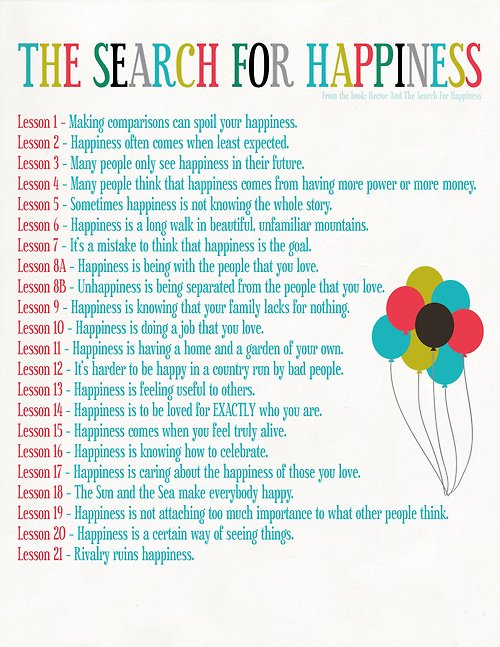

I really loved this simple book, Hector and the Search for Happiness, so I thought you might enjoy hearing my favorite parts in a quick review. Here are Hector's 22 lessons on happiness.
My good friend Matt has a lot of sayings and by far one of the most popular is, “Living the dream.” He talks about some of his friends who live the dream, like his buddy who has played golf with Obama more times than anyone on the planet. He’s living the dream. He talks about people who travel the world and live in Thailand, owning a place on the beach in some exotic locale. Now, that’s the dream. He also, in a humble way, is a pretty epic guy and lives the dream in a unique and different way every day.
All this begs the question, “What is the dream exactly?”
That’s the tricky part.
The dream is all about you… not me, not him or her or anyone else.
What is your dream?
Living on the beach and making just enough money cleaning the earwax out of tourists and surfers to live there forever?
Sitting around and doing nothing except play World of Warcraft?
Relaxing and fishing all day every day until you die peacefully in your canoe?
I think any good dream life has a variety of key elements:
Unfortunately, we have a tendency as a society to over-emphasize certain elements: relaxation and fun. Watch any beer commercial to get a taste of that. Kicking off our sandals at the beach until the sun goes down. Watching football and eating pizza all day long. Playing pool, hanging out, drinking, dancing, partying.
Ask anyone who has done those things for an extended period of time. They get old. But you wouldn’t know that by the blissful faces on the commercials.
Productivity gets old too, obviously. We all know what long high school essays feel like, what studying for tests, filling out forms, going to meetings, clocking in, clocking out and sitting in traffic feel like. These things get old too.
And family and community, though wonderful, can become overwhelming and exhausting too. Thanksgiving may start out great, and I hope it does for you this week, but by the end of December I bet you’ll be a bit frazzled. It can all be a bit too much.
So “the dream” can’t be just one thing can it? It’s about variety.
Once we realize that, we’ve unlocked the secret.
We create our dream life by figuring out what real relaxation, fun, productivity, family and community look like for us. We get to decide the ratios and the location. What get to choose what fits best with our spirituality, philosophy and values. And we get to choose who we surround ourselves with as we enjoy every one of these elements.
Do this little activity with me. Take out a piece of paper if it would be helpful.
Imagine yourself 5 years from now. You’re living the dream! You can proudly and peacefully say that you are really living your dream. Imagine the smile on your face. How do you look? Where are you standing? Who is around you?
Now picturing yourself 5 years from now living the dream, answer these five questions by listing a few ideas next to each:
The beauty of this method is that it helps you realize that you probably aren’t 5 years away.
You’re probably much closer to this dream than you realize.
Look at your list again.
What are some little steps you can take this week to start stepping toward that dream?
Who can you ask for help?
What would you like to do today to get started?
Peter Diamandis shared these principles this week and will be talking about them more in his upcoming book BOLD next year. I love them. Feel free to write them on your wall or use them as a filter for your next big idea but, above all, don't ignore them.
Google's MTP is to "organize the world's information," Singularity University's is to "positively impact the lives of a billion people in ten years," and XPRIZE's is "Making the impossible possible." What's yours?
 Last week I had the unique opportunity to present at my first academic conference. It was the 11th Annual Social Entrepreneurship Conference, which is the largest academic conference on social entrepreneurship in the world, with attendees coming from every corner of the globe.
I was a bit surprised, to be honest, when our paper was chosen for the conference. Almost everyone else attending the conference was either a Ph.D. student or an established professor in the field. With the encouragement of my professor and advisor Dr. Aqeel Tirmizi we prepared and attended the conference together as colleagues. It was a lot of fun, we presented to a packed room with standing room only, and I was able to give away lots of incredible gifts like A Philosopher's Notes, Optimal Living 101, the B Corps Handbook and more thanks to the generosity of en*theos and B Lab who shared the goodies with me.
Last week I had the unique opportunity to present at my first academic conference. It was the 11th Annual Social Entrepreneurship Conference, which is the largest academic conference on social entrepreneurship in the world, with attendees coming from every corner of the globe.
I was a bit surprised, to be honest, when our paper was chosen for the conference. Almost everyone else attending the conference was either a Ph.D. student or an established professor in the field. With the encouragement of my professor and advisor Dr. Aqeel Tirmizi we prepared and attended the conference together as colleagues. It was a lot of fun, we presented to a packed room with standing room only, and I was able to give away lots of incredible gifts like A Philosopher's Notes, Optimal Living 101, the B Corps Handbook and more thanks to the generosity of en*theos and B Lab who shared the goodies with me.
I've included my presentation below in case you want to check it out. In addition to Suncommon and New Media Group, who I highlighted in my original Leading Happiness research, I also conducted several new interviews for this presentation and added en*theos into the mix. Super exciting!
I loved the experience of the conference, learned a lot and received great feedback and support from professionals in our audience. Here are 5 of my favorite things I learned:
All in all I had a wonderful time and I'm very grateful to Aqeel and the conference for the opportunity to share and learn so much. Thank you also to Judy, our wonderful Peace Corps friend, who kindly hosted Tunga and I during our week on the northeastern coast.
I'm excited to see where things will go from here and to share more with you soon!