The 4-Hour Workweek: A Summary
A book I read a long time ago and loved — Tim Ferriss’s four steps, then where its ideas showed up in my own life.
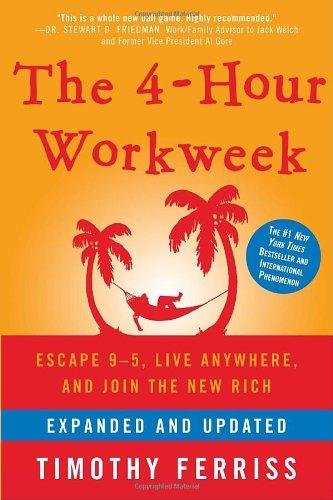
The 4-Hour Workweek
Timothy Ferriss · Escape 9–5, Live Anywhere, and Join the New Rich · first published 2007
Get the book on AmazonI read The 4-Hour Workweek a long time ago and loved it. Its ideas kept turning up in my writing for years: in 2010 I wrote about its take on the 80/20 rule, in 2011 I sent a friend its fisherman story (“the story is on page 231”), and the same year I gave myself a mini-retirement in Mongolia.
Ferriss’s big idea is that you don’t have to save your life for the end of it. He writes about the New Rich: people who measure wealth in time and mobility, not only money, and who spread “retirement” through their lives instead of deferring it to 65. His route there has four steps, and their first letters spell DEAL: Definition, Elimination, Automation and Liberation.
The DEAL at a Glance
- Definition. Decide what you actually want, what it costs, and what you’re afraid of.
- Elimination. Cut the work and information that don’t matter, and the time frees itself.
- Automation. Build income and systems that don’t need you there every hour.
- Liberation. Get free of one fixed place, and use the freedom well.
The DEAL, Explained
1. Definition
- Relative income beats absolute income. A big salary for an eighty-hour week can be worth less per hour than a modest one for a short week. Ferriss counts money together with the time you have to spend it.
- Fear-setting. Instead of goal-setting alone, write down the worst that could realistically happen if you made the change, how you’d repair it, what you’d gain, and what it costs you to keep putting it off. Most fears shrink on paper. As he puts it, “what we fear doing most is usually what we most need to do.”
- Dreamlining. List what you want to have, be and do in six and twelve months, then price each dream per month. The total is your Target Monthly Income, and it’s usually far smaller than people assume.
- The unrealistic is easier. So few people aim high that there’s less competition for big goals than for modest ones.
2. Elimination
- The 80/20 rule. About 80% of results come from 20% of causes. Find the few customers, tasks and habits that create most of your income and most of your trouble, then do more of the first and less of the second.
- Parkinson’s Law. Work expands to fill the time you give it. Short, firm deadlines force you to work on what matters. Being busy and being productive are not the same thing.
- The low-information diet. Practice selective ignorance: skip most news, ask what you’ll actually use, and try a week with no news at all.
- Interrupting interruption. Check email at set times instead of all day, keep meetings short and with a clear purpose, and get comfortable saying no.
3. Automation
- Outsource the small stuff. Hand off routine tasks to a virtual assistant, starting small and giving clear instructions. It’s practice in managing others as much as a time saver.
- Find a “muse.” Ferriss’s name for a small product business that brings in income without your daily time. Test whether people will buy before you build anything.
- Management by absence. Give the people who help you rules and authority to solve problems without asking you, so the business doesn’t stop when you step away.
4. Liberation
- The disappearing act. If you have a job, show you’re more productive away from the office, then propose a trial of working remotely and build from there.
- Mini-retirements. Instead of one long retirement at the end, take extended stays somewhere new throughout life, staying long enough to live there rather than tour. Living abroad can cost less than living at home.
- Filling the void. Free time alone doesn’t make a good life. Ferriss ends with learning and service as what to do with the time once you have it.
The Fisherman Story
Near the end of the book Ferriss retells an old parable. An American businessman meets a fisherman in a small Mexican village who works a few hours a day and spends the rest with his family, his friends and his guitar. The businessman lays out a plan: fish more, buy a bigger boat, then a fleet, move to the city, take the company public and get rich. And then? Then, he says, you could retire to a small village, fish a little, and spend your days with your family and friends. The fisherman is already there.
Where It Showed Up in My Life
I don’t have highlights from this one (I read it long before my Kindle), but I do have what I wrote while its ideas were working on me.
In October 2010, from How the 80/20 Rule May Matter for You:
I can get a tremendous amount of work done (80%) in a very short period of time (20%) when I am passionate, focused and free of worry.
The take home lesson for me has been focusing on the passionate 20% time and letting go of the worrisome 80% whether I am writing, working on projects or trying to prioritize my time.
Me, 2010
In the fall of 2011, after three years of Peace Corps in Mongolia, from a post called “Giving Yourself a Mini-Retirement”:
Mini-retirements have always seemed much better.
Every Peace Corps Volunteer gets about $8,000 at the end of their service… This is more than enough money for me to live in Mongolia for a year, spend more quality time with my wife, launch my legacy project, reconnect with people I love, read 50 awesome books, take incredible online classes and consult in the nonprofit world as well.
Me, 2011
And in 2012, in my book Enough:
In my case, I found that this would sometimes include working 4-hour days, 12-hour days, a weekend here and there, and several days “off” in between.
Write your own definition of success. Create your own job description. Give yourself a mini-retirement. Create a legacy project you believe in.
Me, Enough, 2012
If you only try one thing from the book, try fear-setting: write down the worst case of the change you keep putting off, and how you’d recover from it. It’s usually smaller than it feels.
Resources
- The 4-Hour Workweek on Amazon
- Tim Ferriss’s blog
- The 4-Hour Workweek on Wikipedia
- The Pathless Path and Anything You Want, two more books I’ve summarized about building a life on your own terms
- My own Why You Should Never Check Your Email in the Morning and The Art of Delegating
- More of my book summaries and reviews on Books I Love