Sophie’s World by Jostein Gaarder
A novel about the history of philosophy that I couldn’t put down.
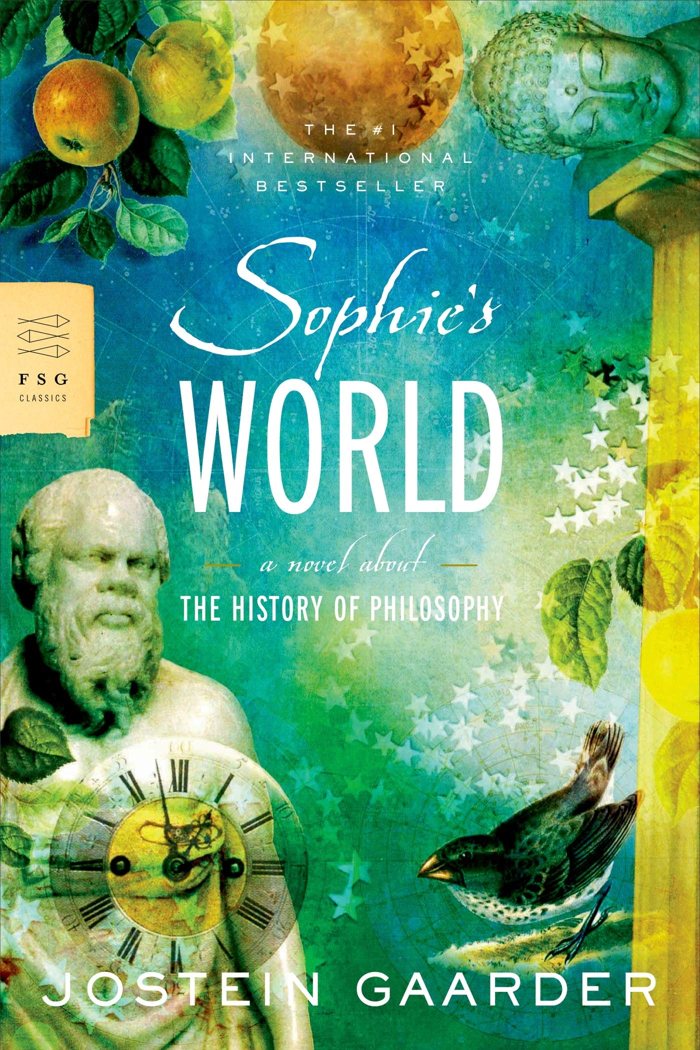
My review (2010)
I just finished reading a great novel that I couldn't put down for several hours yesterday, which is saying something coming from a guy who only reads fiction as often as he watches television. In fact, I walked around doing laundry and chores while reading it which surprised even me. Maybe it's because the novel mixed philosophy (which I love), the whole of human history and an ingenuous turn of events that made me speed through the book. It really is, as The Washington Post said, "a whimsical and ingenious mystery novel that also happens to be a history of philosophy."
If you're even a little interested in philosophy or any of the big questions like, "Who am I?", "Where did we come from?", "Where are we going?", "Is there a God?" and "What's the point of life?" than you will probably love Sophie's World. It has renewed my interest in both fiction literature and philosophy as a whole. I must admit that I was one of the many people who Goethe warned about when he said, "He who cannot drawn on three thousand years is living from hand to mouth." Thanks Jostein and Todd, for helping me draw on quite a bit more than I did before.
What Sophie’s World is about
Fourteen-year-old Sophie Amundsen comes home in Norway to find a note in the mailbox with two questions: Who are you? and Where does the world come from? More letters follow from a mysterious philosopher, Alberto Knox, and a correspondence course in the history of philosophy begins — alongside a second mystery: postcards addressed to a girl named Hilde, from her father, a UN officer in Lebanon.
- Wonder is where philosophy starts. The one thing you need to be a good philosopher is the ability to be amazed. Children have it; most adults lose it as the world starts to feel ordinary.
- The white rabbit. Alberto’s favorite image: the universe is a white rabbit pulled out of a magician’s hat. Most people burrow down into its fur and get comfortable. Philosophers climb up the fine hairs to look the magician in the eye.
- A tour of three thousand years. The lessons walk through the whole story of Western thought: the natural philosophers and Democritus, Socrates, Plato and Aristotle, the Middle Ages and the Renaissance, Descartes, Spinoza, Locke, Hume, Berkeley and Kant, then the Romantics, Hegel, Kierkegaard, Marx, Darwin, Freud and Sartre, ending with the Big Bang.
- Every thinker answers the same big questions. Who am I? Where did we come from? Is there a God? What’s the point of life? Watching each philosopher take a turn at them is what makes the history feel alive instead of like a textbook.
- The story is part of the lesson. Without spoiling it: halfway through, Sophie and Alberto start to suspect that their own world isn’t what it seems — which turns questions like Berkeley’s “is anything real?” into a plot twist.
First published in Norwegian in 1991 and in English in 1994, Sophie’s World became one of the best-selling books of the decade and has been translated into more than 50 languages.
Resources
- Sophie’s World on Wikipedia
- More philosophy, distilled: A Philosopher’s Notes by Brian Johnson
- More book summaries and reviews on Books I Love