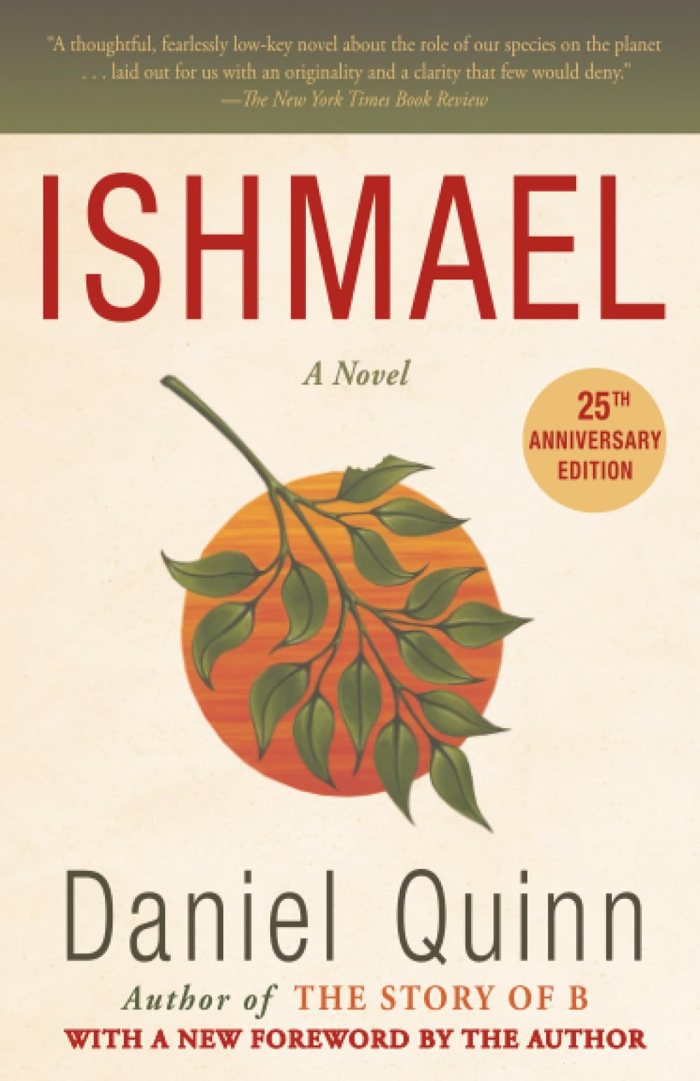
Ishmael by Daniel Quinn
Leavers and Takers: one of my favorite books ever, and the movie it inspired.
My review (2008)
I can't believe I haven't written about this before, but Ishmael by Daniel Quinn is one of my favorite books ever and consequently the movie Instinct (inspired by the book) starring Anthony Hopkins and Cuba Gooding, Jr. is one of my favorite movies. My dad, brother and I just watched it and I remembered me of how awesome it is.
Here's the general idea of both the book and the movie: humankind as we know it didn't always exist as it does now. We didn't always own land, or exterminate species including other humans just because we wanted to. We didn't eat more than we needed to eat or take more than we needed to take. We lived in the wild not outside it, and we lived with animals not in fear of them. In the simplest terms we were Leavers, not Takers. Takers have dominion over animals, subdue tracks of land all around them, store up excess animals and crops, kill all animals that compete with or kill the domesticated animals, and live under the illusion that it is their right and good to do all of these things. By contrast, as Anthony Hopkins says in the movie, "tribal societies - hunters, gatherers, planters. They never killed more animals than they could use. They never ploughed more land than they needed. They fought, but they never waged war. Never exterminated. They had a place in the world. And in the world, they were part of it. And they shared it." Ten thousand years ago we changed that. If you are interested in the rest of the story, I highly suggest both the book and the movie. As one reviewer from the Whole Earth Review said, "From now on I will divide the books I have read into two categories -- the ones I read before Ishmael and those read after."
The big ideas in Ishmael
The setup is simple and strange: a man answers a newspaper ad — “Teacher seeks pupil. Must have an earnest desire to save the world” — and finds that the teacher is a gorilla named Ishmael. Their conversations are the whole book. Here are the ideas that make people divide their reading into before Ishmael and after.
- Every culture is enacting a story. We don’t just live in a culture; we live out a story about what the world is, who we are and why we’re here. It’s so familiar we can’t hear it — Ishmael calls the voice that tells it Mother Culture.
- Takers and Leavers. Quinn splits humanity into two groups. Leavers are the tribal peoples who lived as part of the world for most of human history. Takers are the culture that began with totalitarian agriculture about ten thousand years ago, and spread across the planet.
- The Taker story: the world was made for us. The story our culture tells is that the world belongs to humankind, that we’re the end point of creation, and that our job is to conquer and rule it. Almost everything that follows — from extinctions to endless growth — comes out of that belief.
- There is a law of life, and we’re breaking it. Ishmael describes a law every other species follows: compete as hard as you can, but don’t hunt down your competitors, destroy their food or keep them from it. Takers treat any creature that competes with their crops and herds as an enemy to wipe out.
- More food, more people. One of the book’s most debated arguments: increasing food production doesn’t end hunger so much as fuel population growth, which demands more food again.
- We think we’re flying; we’re falling. Ishmael compares our civilization to an early aviator who jumps off a cliff in a flapping contraption and enjoys the view on the way down. The ground is coming, and the craft was never built to fly.
- There is another story. The hopeful turn: the Leaver way — living as part of the community of life rather than above it — is still available. Changing the world starts with changing the story in people’s minds.
Quinn continued the story in The Story of B and My Ishmael. The novel won the Turner Tomorrow Fellowship in 1991, and the Anthony Hopkins film Instinct, which I mention in my review, was inspired by it.
Resources
- Ishmael.org, the official home of Daniel Quinn’s work
- Ishmael on Wikipedia
- More book summaries and reviews on Books I Love