CLEP Out
Of all the advice I have given to fellow and incoming college students, I think some of the most valuable has been, "Take CLEP exams." I, and many of my friends, have placed out of English Composition (101 & 102), English Literature (201 & 202), Spanish and French (up to 202) and many other courses as well. Why take years of classes for thousands of dollars when you could take a test to place out of them for under a hundred dollars? "I just didn't know I could," is the most common answer. Well, here it is. Now you know.
CLEP® (College-Level Examination Program®) exams are official tests given by The College Board (the makers of the SAT) which count for credit at approximately 2,900 college institutions nationwide. In the Official Study Guide for CLEP, The College Board writes:
CLEP is based on the premise that some individuals enrolling in college have already learned part of what is taught in college courses through noncredit adult courses, job training, independent reading and study, and advanced high-school courses. CLEP provides these individuals with the opportunity to demonstrate their college-level learning by taking exams that assess the knowledge and skills taught in college courses.
CLEP Exams
These CLEP exams, covering topics such as Freshman Composition, American Literature, Spanish Language, Western Civilizations I & II, Biology and Calculus, correlate directly into full credit for required courses at Campbell and anyone can take them. Here is a list of select exams and the course credit they correlate into at Campbell:
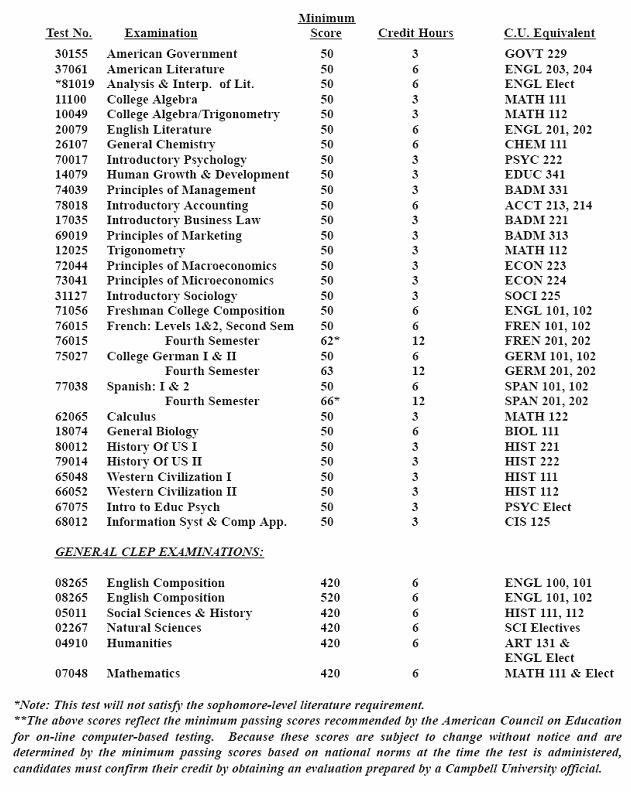
Campbell’s 2005–2006 list as text
| Test no. | CLEP exam | Min. score | Credits | Campbell course |
|---|---|---|---|---|
| 30155 | American Government | 50 | 3 | GOVT 229 |
| 37061 | American Literature | 50 | 6 | ENGL 203, 204 |
| 81019* | Analysis & Interpretation of Literature | 50 | 6 | ENGL elective |
| 11100 | College Algebra | 50 | 3 | MATH 111 |
| 10049 | College Algebra/Trigonometry | 50 | 3 | MATH 112 |
| 20079 | English Literature | 50 | 6 | ENGL 201, 202 |
| 26107 | General Chemistry | 50 | 6 | CHEM 111 |
| 70017 | Introductory Psychology | 50 | 3 | PSYC 222 |
| 14079 | Human Growth & Development | 50 | 3 | EDUC 341 |
| 74039 | Principles of Management | 50 | 3 | BADM 331 |
| 78018 | Introductory Accounting | 50 | 6 | ACCT 213, 214 |
| 17035 | Introductory Business Law | 50 | 3 | BADM 221 |
| 69019 | Principles of Marketing | 50 | 3 | BADM 313 |
| 12025 | Trigonometry | 50 | 3 | MATH 112 |
| 72044 | Principles of Macroeconomics | 50 | 3 | ECON 223 |
| 73041 | Principles of Microeconomics | 50 | 3 | ECON 224 |
| 31127 | Introductory Sociology | 50 | 3 | SOCI 225 |
| 71056 | Freshman College Composition | 50 | 6 | ENGL 101, 102 |
| 76015 | French, Levels 1 & 2: second semester | 50 | 6 | FREN 101, 102 |
| 76015 | French: fourth semester | 62* | 12 | FREN 201, 202 |
| 75027 | College German I & II | 50 | 6 | GERM 101, 102 |
| German: fourth semester | 63 | 12 | GERM 201, 202 | |
| 77038 | Spanish I & II | 50 | 6 | SPAN 101, 102 |
| Spanish: fourth semester | 66* | 12 | SPAN 201, 202 | |
| 62065 | Calculus | 50 | 3 | MATH 122 |
| 18074 | General Biology | 50 | 6 | BIOL 111 |
| 80012 | History of the U.S. I | 50 | 3 | HIST 221 |
| 79014 | History of the U.S. II | 50 | 3 | HIST 222 |
| 65048 | Western Civilization I | 50 | 3 | HIST 111 |
| 66052 | Western Civilization II | 50 | 3 | HIST 112 |
| 67075 | Introduction to Educational Psychology | 50 | 3 | PSYC elective |
| 68012 | Information Systems & Computer Applications | 50 | 3 | CIS 125 |
| General CLEP examinations | ||||
| 08265 | English Composition | 420 | 6 | ENGL 100, 101 |
| 08265 | English Composition | 520 | 6 | ENGL 101, 102 |
| 05011 | Social Sciences & History | 420 | 6 | HIST 111, 112 |
| 02267 | Natural Sciences | 420 | 6 | Science electives |
| 04910 | Humanities | 420 | 6 | ART 131 & ENGL elective |
| 07048 | Mathematics | 420 | 6 | MATH 111 & elective |
* As printed on Campbell’s list; its note says Analysis & Interpretation of Literature did not meet the sophomore literature requirement. Campbell based the scores on the American Council on Education’s minimums for the computer-based tests, said they could change without notice, and asked students to confirm their credit with a Campbell official.
Although this information is up-to-date as of the 2005-2006 school year, it is important to remember that it can change. Campbell University reserves the right to add stipulations to what credit they will and will not accept and it is important for each student to realize that before they take their particular test. Simply ask the registrar about your particular test and they will tell you what they plan to give you credit for on your transcript.
CLEP today
Checked against the College Board’s CLEP site and Campbell University’s pages on October 12, 2026. Prices and rules change, so confirm before you register.
| In this post | October 2026 | |
|---|---|---|
| Exams | 34 | 34, some renamed or replaced, one new |
| Exam fee | $55 | $97 |
| Other fees | About $10 at the test center | The test center’s own fee (each center sets it), or $30 to test at home |
| Where | Over 1,300 U.S. testing locations | More than 2,000 test centers worldwide, or at home with a live online proctor |
| How long | 2 to 3 hours | About 90 minutes for most exams; College Composition takes 125 |
| Colleges that give credit | About 2,900 | More than 2,900 |
| Study guide | The Official Study Guide, $25, for all 34 exams | The book is no longer sold by the College Board; a $10 guide for each exam, plus free sample questions |
| End of the test | “Would you like for this test to be scored?” | You can still cancel your score, but only before you see it |
The 34 CLEP exams
What happened to the exams on Campbell’s 2005–06 list
- Same exams, other names: Campbell’s list used older or shorter names for some exams, and a few have been renamed since. Today they are Analyzing and Interpreting Literature (Analysis & Interpretation of Literature on the list), Biology (General Biology), Chemistry (General Chemistry), Information Systems (Information Systems & Computer Applications), College Mathematics (Mathematics), and French, German and Spanish Language: Levels 1 and 2.
- Replaced: College Algebra/Trigonometry and Trigonometry gave way to Precalculus in 2006. Introductory Accounting, a two-semester exam, gave way to the one-semester Financial Accounting in 2007. Freshman College Composition and the general English Composition exam became College Composition Modular in 2010, and English Composition with Essay became College Composition, which has two essays.
- New since then: Spanish with Writing, a Spanish exam with two writing tasks.
- Scores and credits: since 2001 every CLEP exam is scored from 20 to 80, so the 420 and 520 minimums the list gives the general exams come from an older scale. For Level 2 of the languages the recommended score has dropped (59 for French, from 62; 60 for German, from 63; 63 for Spanish, from 66), and Level 2 now earns 9 credits, not 12.
- Still offered: everything else on the list, some under longer names, like History of the United States I: Early Colonization to 1877.
How CLEP works now
- Cost. $97 per exam, plus either the test center’s own administration fee (each center sets it, so ask; Modern States says most charge $20 to $30) or a $30 fee to take it at home with remote proctoring.
- At home. All 34 exams can be taken at home, watched by a live proctor over video. You need to be 13 or older (18 in Illinois) and live in the U.S., not counting the territories, unless the military’s DANTES program pays for your exam. You also need a Windows 10 or 11 PC you have administrator rights on, with Chrome, a camera, a microphone, a speaker and a wired keyboard and mouse (no Macs, tablets or Chromebooks), plus a smartphone as a second camera. Check the full requirements before you pay.
- Test centers. There are more than 2,000, and exams run year-round with no set test dates: you buy the exam online, then book a time with a center. Some centers test only their own students, so check first. A paid exam has to be used within six months (by June 30 if a voucher paid for it), and you can get a refund only within seven days of buying it.
- Scores. Every exam is scored from 20 to 80, and ACE recommends credit at 50, the equal of a C in the course (higher for Level 2 of the languages). Wrong answers cost nothing, so answer every question. Your score shows on the screen as soon as you finish, except for College Composition and Spanish with Writing, which take two to three weeks because people grade the writing.
- Canceling and retakes. You can still cancel a score at the end of the exam, but only before you see it; the fee isn’t refunded. You have to wait three months to retake the same exam, whether you canceled or didn’t pass.
- Sending scores. Sending them to two colleges is free when you register; after that each transcript is $20. Scores from exams taken since July 1, 2022 are kept for 10 years, and older ones for 20, so scores from when this post was written are reaching that limit now: send them soon if you still need them.
- Credit. More than 2,900 colleges give CLEP credit, and each one sets its own scores and credits. Look yours up with the College Board’s CLEP College Credit Policy Search, then confirm in the college’s own catalog: the College Board says some colleges don’t keep their listing current. Some colleges won’t give credit for an exam if you’ve already taken a similar course.
- Studying. The College Board sells a $10 exam guide for each exam, and each exam’s page has free sample questions and a study plan. The nonprofit Modern States offers 32 free online courses for CLEP exams.
- Free exams. For service members (and some military spouses and Air Force civilian employees), DANTES pays for the first try at each exam, and on-base test centers waive their fee for them (military benefits). Veterans with GI Bill benefits can be paid back, but it uses up some of their GI Bill entitlement. Modern States gives a free voucher to anyone 13 or older who finishes one of its courses and scores at least 75% on its final; the voucher covers the exam fee and the at-home fee, and Modern States pays back a test center’s fee if you claim it within a year. Get the voucher before you register: Modern States won’t pay for an exam you already bought.
At Campbell today
- Campbell still gives credit for CLEP: under its 2026–2027 catalog it may grant credit for scores of 50 or higher, as ACE recommends. The credit shows as “CR” on your transcript and doesn’t count in your GPA. Send an official score report to the Registrar (Campbell’s CLEP code is 5100).
- Credit for core-curriculum courses has to reach Campbell before the end of your first semester there. CLEP counts toward the 90 credits you can bring in from outside, your last 32 hours have to be at Campbell, and you can’t get credit twice for the same course, so College Algebra and College Mathematics, Western Civilization I and Social Sciences and History, or the two composition exams overlap.
- Campbell’s current CLEP list (its 2025 guide, though the footer still says 2019) mostly follows ACE, with a few differences: it doesn’t accept Introduction to Educational Psychology; Biology and Chemistry earn 4 credits each; English Literature earns 3 and College Mathematics 6; and for French, German and Spanish, Level 2 credit starts at a score of 66, with 71 or higher covering 201 and 202. Its testing center links a March 2025 brochure that differs (Biology 6 credits, ACE’s language scores), so ask the Registrar which applies.
- The College Board’s own listing for Campbell is out of date (it still shows Introduction to Educational Psychology for credit), so go by Campbell’s current list (linked above), not the 2005–06 one on this page, and check with the Registrar.
- Campbell’s National Testing Center gives CLEP exams at Fort Bragg and Pope, both on base, so civilians need clearance to get in. Testing there is free for Campbell students and active-duty service members and $15 an hour for anyone else; that’s the center’s fee, and the $97 exam fee still applies unless DANTES pays it.
Taking the CLEP Exam
Now that you are ready to take your CLEP exam, there are a few things you need to know:
First, you need to plan on studying for the exam. It might seem surprising that you should study first, but it really makes sense. It is easy to forget things from classes that were years ago and we could all do for a little brush up on most subjects. The College Board provides an excellent Official Study Guide which I would highly recommend. It covers all of their 34 exams and only costs $25. Although you can also purchase individual test reviews online in PDF form for $10, but these are only sections out of the Official Study Guide and this is not very cost effective. I would recommend just buying the book and sharing it with your friends. You never know when you’ll take another CLEP exam or when your friends might really like the idea themselves. Also, reviewing for your test can be done on your own. Depending upon the subject being tested, use your previous notes from classes, books from those classes, or review materials that are available at the bookstore. The Complete Idiot’s Guide to American Literature, for example, has helped quite a few students review for the American Literature CLEP test and they passed the test the first time. Search for books yourself, ask around and use the Official Study Guide practice tests (already within the book) to test yourself on the material.
Second, you need to decide on a place to take the exam. There are over 1,300 testing locations in the United States and Campbell has a new locations nearby including Fayetteville State University, Methodist College and Barton College. For a full list, visit The College Board website and serach CLEP Test Centers. Once you decide on a location, call them and ask them about what days they provide testing. Usually a CLEP test requires 2 to 3 hours to complete and most offices are open atleast 2 days a week. Decide on a day and time to take the test and then reserve your spot with the testing center. For Fayetteville State you will need to use the following form to reserve your spot. Congratulations, you are now ready to take the test!
Finally you will arrive at the testing center. Here you will get a little paperwork to fill out in registration for the test and you will also have to pay a small fee. The examinations cost $55 each and the testing center will likely charge around $10 for processing. After filling out this information and paying for the test, you will be led to a computer and allowed to begin on your test. Again, expect around 2-3 hours depending on which test you are taking. It will be self-timed and will conclude with a single question, “Would you like for this test to be scored?” If you feel like you received the required score to pass the test, feel free to click “heck yes.” Then the test will be scored automatically and you will be notified of the result. If you select “no”, the test will not be scored and Campbell will receive no notification of your result.
Today: $97 per exam, plus either the test center’s own fee or $30 to test at home, and most exams take about 90 minutes. More in CLEP today ↑
CLEP testing is a great way to receive credit for what you already know and I hope you all enjoy it. Good luck and tell your friends!